
The Archive
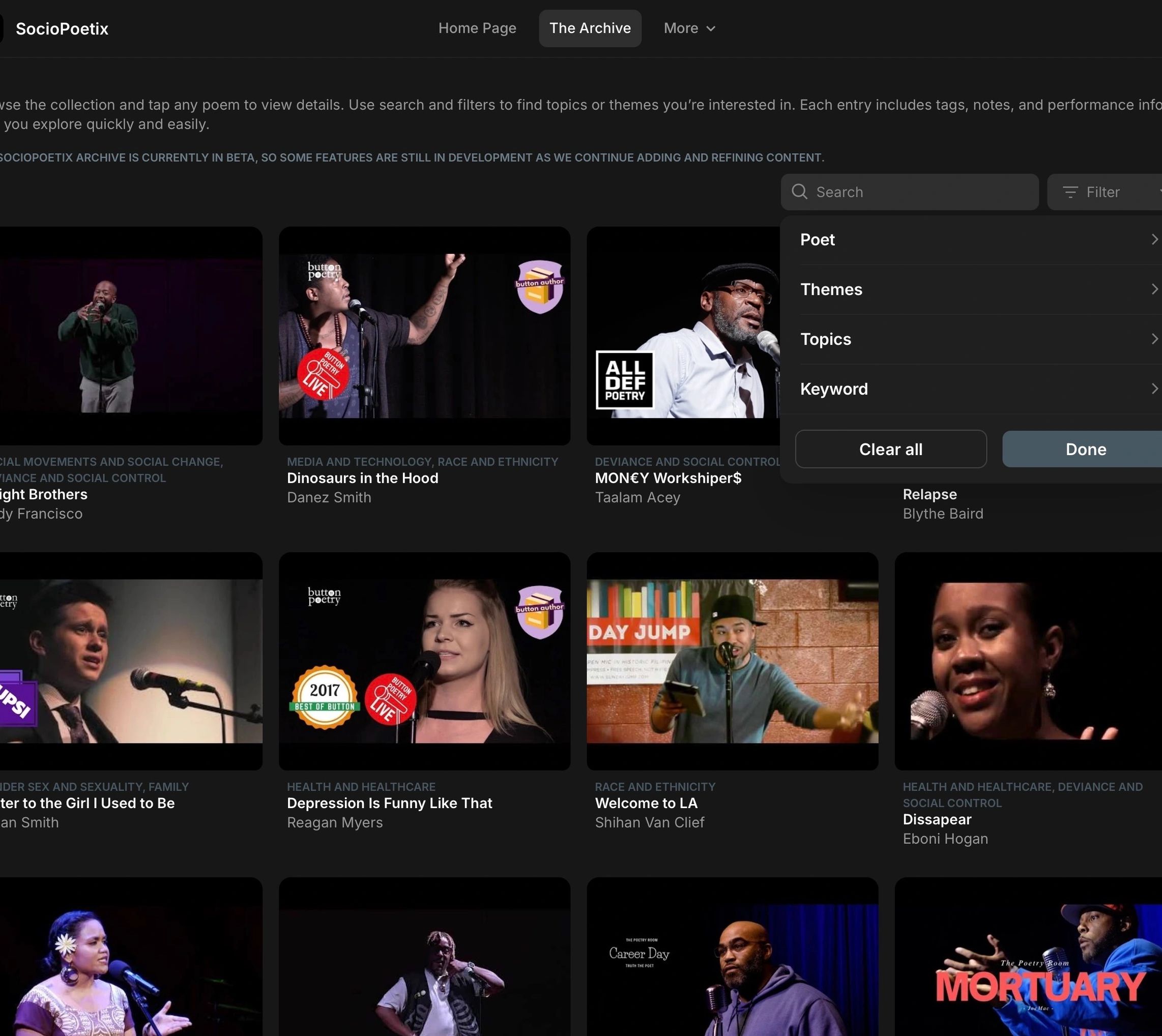
The SocioPoetix Archive is an interactive database that organizes spoken word poetry through sociological themes, concepts, and keywords. It allows you to engage poetry not just as art, but as a way of analyzing how people experience and respond to social structures, identity, power, and inequality in everyday life.
Inside the Archive
When you click on a poem, you’ll find everything you need to engage with it sociologically, all in one place.
At the top, the poem’s title and poet are clearly identified, followed immediately by a written summary and analysis giving you the sociological framing before you even press play. The summary explains not just what the poem says, but what it reveals about power, identity, inequality, and the structures that shape our lives.
Next, an embedded YouTube video lets you watch the performance directly in the archive — no searching, no redirects, just the poem.
Below the video, each poem is tagged with its sociological themes, topics, and keywords. Themes give you the broad sociological lens, such as Race and Ethnicity or Deviance and Social Control. Topics narrow the focus to more specific conversations within that theme. Keywords connect the poem to precise sociological concepts and vocabulary, making it easy to draw connections across the archive.
Whether you are a student writing a paper, an educator building a lesson, or a researcher tracing a concept across multiple voices, the poem page is designed to do the analytical heavy lifting alongside you.

Searching the Archive
Themes
Keywords
Themes

Themes are the broadest sociological lens in the archive. Each poem is tagged with one or more themes drawn from core areas of sociology — such as Race and Ethnicity, Gender and Sexuality, Deviance and Social Control, or Social Class and Inequality. If you are exploring a particular area of social life or teaching a specific unit, starting with a theme gives you the widest view of what the archive has to offer.
Topics
Keywords
Themes
Topics sit one level below themes and offer more focused entry points into the archive. Where a theme might be Race and Ethnicity, related topics could include systemic racism, colorism, or racial identity. Searching by topic allows you to narrow your focus and find poems that speak directly to a specific conversation, concept, or classroom discussion.
Keywords
Keywords
Keywords
Keywords are the most granular way to search the archive. Every poem is tagged with up to ten sociological keywords — terms drawn directly from sociological theory and research, such as intersectionality, hegemony, cultural capital, or code-switching. If you are looking for poems that connect to a specific sociological concept or term, keyword search will get you there with precision.